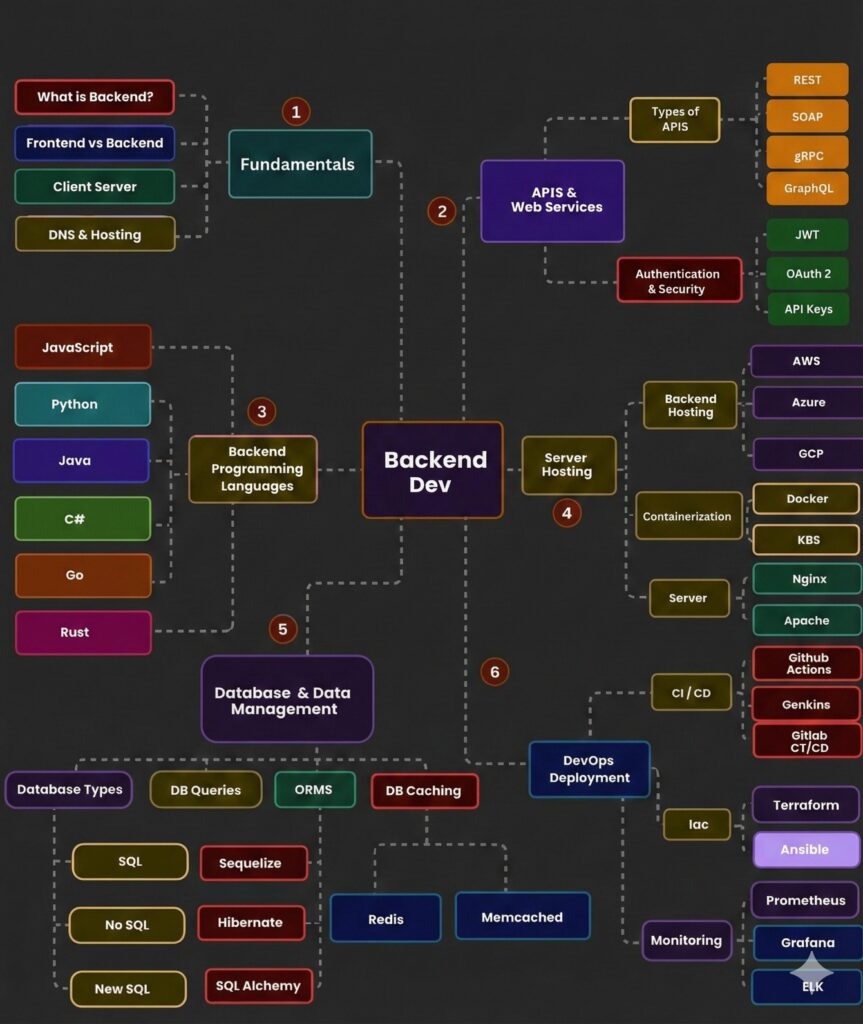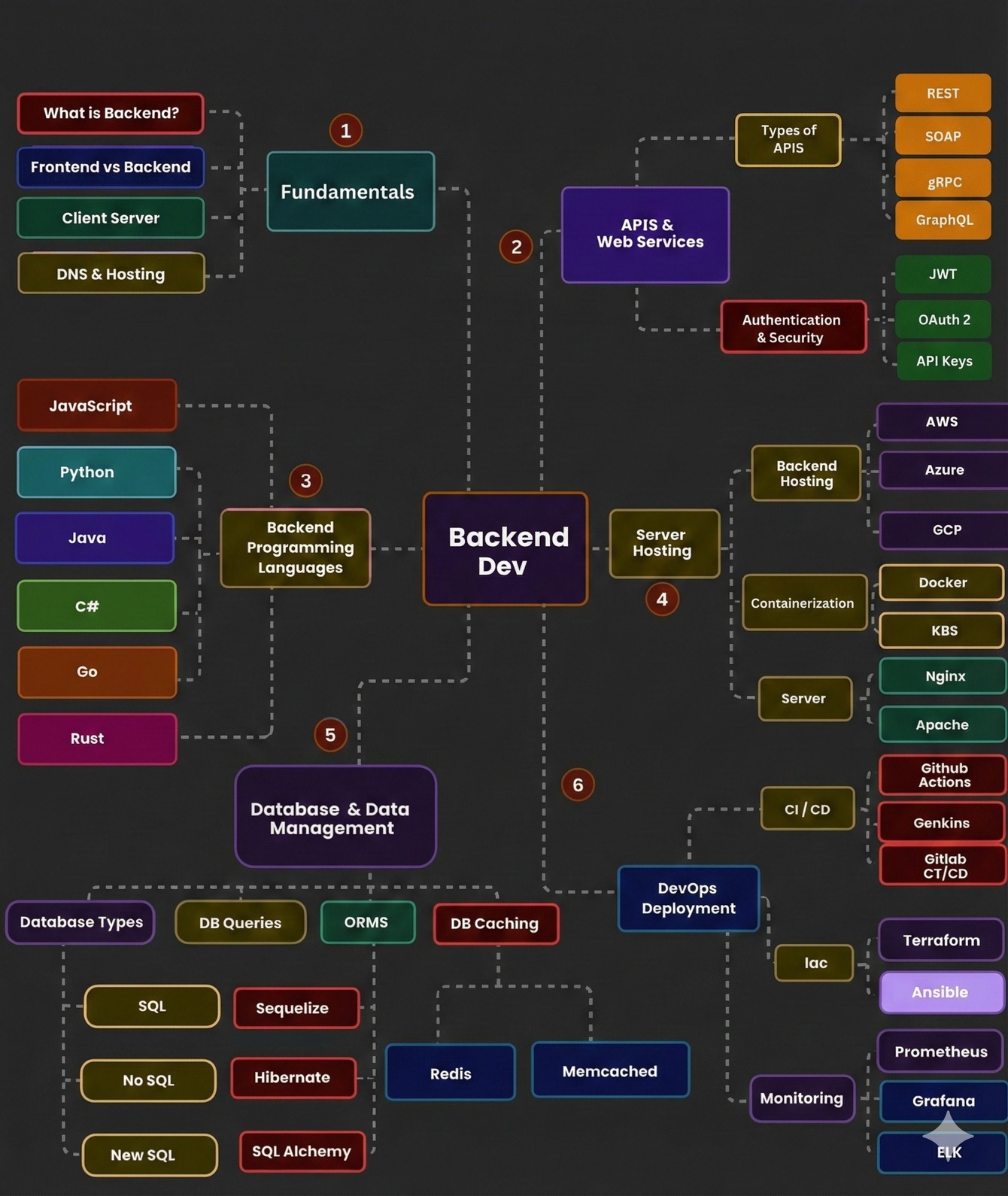
Backend development is the backbone of every web application, handling server-side logic, databases, APIs, and everything that powers the user experience behind the scenes. Whether you’re a fresh graduate stepping into the tech world or an experienced frontend developer looking to expand your skillset, this comprehensive guide will help you navigate your backend development journey.
Understanding the Fundamentals
Before diving into code, it’s crucial to understand what backend development actually means. Backend developers build and maintain the server-side of web applications, managing databases, server logic, APIs, and ensuring everything runs smoothly behind the scenes.
What is Backend Development?
Backend development involves working with servers, databases, and application logic that users don’t directly see. When you submit a form, log into your account, or purchase something online, backend systems process these requests, interact with databases, and send responses back to your browser.
Frontend vs Backend: Understanding the Divide
The frontend is what users see and interact with (HTML, CSS, JavaScript running in the browser), while the backend handles data processing, business logic, authentication, and database operations on the server. Modern applications require both to work seamlessly together.
Client-Server Architecture
Understanding how clients (browsers, mobile apps) communicate with servers is fundamental. When you type a URL, your browser sends a request to a server, which processes it and sends back a response. This request-response cycle is the foundation of web development.
DNS & Hosting Basics
Domain Name System (DNS) translates human-readable domain names into IP addresses. Hosting is where your application lives on the internet. Understanding these concepts helps you deploy and manage applications effectively.
Choosing Your Backend Programming Language
One of the first decisions you’ll make is selecting a programming language. Each has its strengths, community support, and use cases.
JavaScript (Node.js)
Best for: Developers who already know JavaScript, full-stack development, real-time applications
Node.js allows you to use JavaScript on the server, making it easier to work on both frontend and backend with a single language. It’s event-driven and non-blocking, making it excellent for I/O-heavy applications.
Learning Resources:
- Node.js Crash Course by Traversy Media
- The Net Ninja’s Node.js Tutorial
- Official Documentation: nodejs.org
Python
Best for: Beginners, data science integration, rapid development, machine learning applications
Python’s clean syntax and extensive libraries make it incredibly beginner-friendly. Django and Flask are popular frameworks that help you build robust applications quickly.
Learning Resources:
- Python Backend Development by freeCodeCamp
- Corey Schafer’s Flask Tutorial
- Official Documentation: python.org
Java
Best for: Enterprise applications, Android development, high-performance systems
Java remains a dominant force in enterprise backend development. Spring Boot has made Java development more accessible and productive than ever.
Learning Resources:
C#
Best for: Windows applications, game development with Unity, enterprise systems
C# with .NET Core offers excellent performance and is Microsoft’s flagship language for backend development.
Learning Resources:
Go (Golang)
Best for: Microservices, cloud-native applications, high-performance systems
Go is designed for simplicity and efficiency, making it popular for building scalable backend services.
Learning Resources:
- Go Programming by Tech With Tim
- Official Documentation: go.dev
Rust
Best for: System programming, performance-critical applications, security-focused projects
Rust offers memory safety without garbage collection, making it ideal for high-performance backend systems.
Learning Resources:
- Rust Crash Course by Traversy Media
- The Rust Book: doc.rust-lang.org/book
Mastering APIs & Web Services
APIs (Application Programming Interfaces) are how different software systems communicate with each other.
Types of APIs
REST (Representational State Transfer): The most common API architecture, using HTTP methods (GET, POST, PUT, DELETE) to perform operations. REST APIs are stateless and use standard HTTP protocols.
SOAP (Simple Object Access Protocol): An older, XML-based protocol still used in enterprise environments. It’s more rigid but offers built-in error handling and security features.
gRPC: A modern, high-performance framework developed by Google that uses Protocol Buffers for serialization. It’s excellent for microservices communication.
GraphQL: A query language for APIs that allows clients to request exactly the data they need, nothing more, nothing less. It’s gaining popularity for its flexibility and efficiency.
Learning Resources:
- REST API Tutorial by Programming with Mosh
- GraphQL Crash Course by Traversy Media
- What is gRPC? by IBM Technology
Authentication & Security
Security is non-negotiable in backend development. Understanding authentication and authorization mechanisms is crucial for protecting user data and application resources.
JWT (JSON Web Tokens): Stateless authentication tokens that contain encoded user information. They’re self-contained and can be verified without database lookups.
OAuth 2.0: An authorization framework that allows third-party applications to access user data without exposing credentials. Think “Login with Google” or “Login with Facebook.”
API Keys: Simple authentication tokens used for server-to-server communication or public API access control.
Learning Resources:
Database & Data Management
Data is the heart of any application, and understanding how to store, retrieve, and manage it efficiently is essential.
Database Types
SQL (Relational Databases): Structured databases that use tables with predefined schemas. Examples include MySQL, PostgreSQL, and Microsoft SQL Server. They’re excellent for complex queries and maintaining data integrity through ACID properties.
NoSQL (Non-Relational Databases): Flexible databases that don’t require fixed schemas. They come in various types:
- Document databases (MongoDB): Store data in JSON-like documents
- Key-value stores (Redis): Simple but extremely fast
- Column-family (Cassandra): Optimized for write-heavy operations
- Graph databases (Neo4j): Perfect for relationship-heavy data
NewSQL: Modern databases that combine SQL’s ACID guarantees with NoSQL’s scalability, like CockroachDB.
Database Concepts
DB Queries: Learn SQL for relational databases and query languages specific to NoSQL databases you choose.
ORMs (Object-Relational Mapping): Tools like Sequelize (Node.js), SQLAlchemy (Python), or Hibernate (Java) that let you interact with databases using your programming language instead of writing raw SQL.
DB Caching: Using Redis or Memcached to store frequently accessed data in memory, dramatically improving application performance.
Learning Resources:
Server Hosting & Deployment
Building applications locally is one thing, but deploying them to production is where the real learning happens.
Server Hosting Options
Traditional Servers: Nginx and Apache are web servers that can serve your application and handle HTTP requests efficiently.
Containerization
Docker: Packages your application with all its dependencies into containers, ensuring consistency across different environments. Docker has revolutionized how we deploy applications.
Kubernetes (K8s): Orchestrates and manages containerized applications at scale, handling deployment, scaling, and management automatically.
Learning Resources:
Cloud Platforms
AWS (Amazon Web Services): The largest cloud provider offering services like EC2 (virtual servers), S3 (storage), Lambda (serverless), and RDS (managed databases).
Azure (Microsoft Azure): Microsoft’s cloud platform, excellent for .NET applications and enterprise integration.
GCP (Google Cloud Platform): Google’s cloud offering with strong support for machine learning and data analytics.
Learning Resources:
DevOps & Deployment
CI/CD (Continuous Integration/Continuous Deployment)
Automating your build, test, and deployment processes saves time and reduces errors. Tools like GitHub Actions, Jenkins, GitLab CI/CD, and CircleCI help you achieve this.
Learning Resources:
Infrastructure as Code
Terraform: Define your infrastructure using code, making it version-controlled and reproducible.
Ansible: Automates software provisioning, configuration management, and application deployment.
Learning Resources:
Monitoring
Prometheus & Grafana: Monitor application performance, track metrics, and visualize data.
ELK Stack (Elasticsearch, Logstash, Kibana): Centralized logging solution for tracking and debugging issues.
Essential Best Practices
Code Quality
- Write clean, readable code with proper documentation
- Follow design patterns (MVC, Repository, Factory, etc.)
- Implement comprehensive error handling
- Write unit and integration tests
Security
- Never store sensitive data in plain text
- Validate and sanitize all user inputs
- Use HTTPS everywhere
- Keep dependencies updated
- Implement rate limiting to prevent abuse
Performance
- Use caching strategically
- Optimize database queries
- Implement pagination for large datasets
- Use CDNs for static assets
- Monitor and profile your application regularly
Scalability
- Design stateless services when possible
- Use load balancers
- Implement database replication
- Consider message queues for async processing
Building Real Projects
Theory is essential, but nothing beats hands-on experience. Here are project ideas to solidify your learning:
Beginner Projects:
- Todo API with user authentication
- Blog platform with comments
- URL shortener service
- Weather API aggregator
Intermediate Projects:
- E-commerce platform with payment integration
- Social media API with real-time features
- Job board with search and filtering
- File upload and sharing service
Advanced Projects:
- Multi-tenant SaaS application
- Real-time chat application with websockets
- Video streaming platform
- Distributed task queue system
Staying Updated
Backend development evolves rapidly. Follow these practices to stay current:
- Read tech blogs (Medium, Dev.to)
- Follow industry leaders on Twitter/X and LinkedIn
- Contribute to open-source projects
- Attend local meetups and conferences
- Join communities (Reddit r/webdev, Discord servers, Stack Overflow)
- Subscribe to newsletters (JavaScript Weekly, Python Weekly, etc.)
Conclusion
Learning backend development is a journey, not a destination. Start with fundamentals, choose one technology stack, build projects, and gradually expand your knowledge. Don’t try to learn everything at once; depth in one area is more valuable than surface-level knowledge of many.
Remember, the best backend developers aren’t those who know every technology, but those who understand core concepts deeply and can apply them to solve real problems. Focus on understanding why things work the way they do, not just how to use them.
Start small, stay consistent, and keep building. Your future self will thank you for the journey you start today.